Wednesday, October 10, 2012

Sew Expensive: Patou Paris Designer


 For today's Sew Expensive post, I have for you a very rare pattern. I know a lot of us were watching this little baby on Ebay and it was pretty clear that something like this was going to go for a whole lot of money.


This beautiful 1920's Pictorial Review 5565 sold on Ebay for an amazing $275.


~ On a side note, I have bought patterns from this seller a few times before and have always been very happy with my purchases. You might want to check out her shop on eBay. ~


So what was so rare about this particular pattern? Sewing patterns from the 1920's are rare just by themselves and don't come up very often. Evening gown patterns from the 1920's are almost impossible to find. Sewing patterns from Pictorial Review and the 1920's are even more rare and sought after but that's not the whole appeal. I think the biggest factor at play in this pattern's value is that it's a designer pattern. Designer patterns from this era are almost unheard of and this one is an original Patou design.

For those of you who aren't familiar with him, Jean Patou was a very popular French designer until his untimely and early death in 1936.


He is well known for eradicating the short boxy 'flapper' look by lengthening skirts and elongating the feminine silhouette.

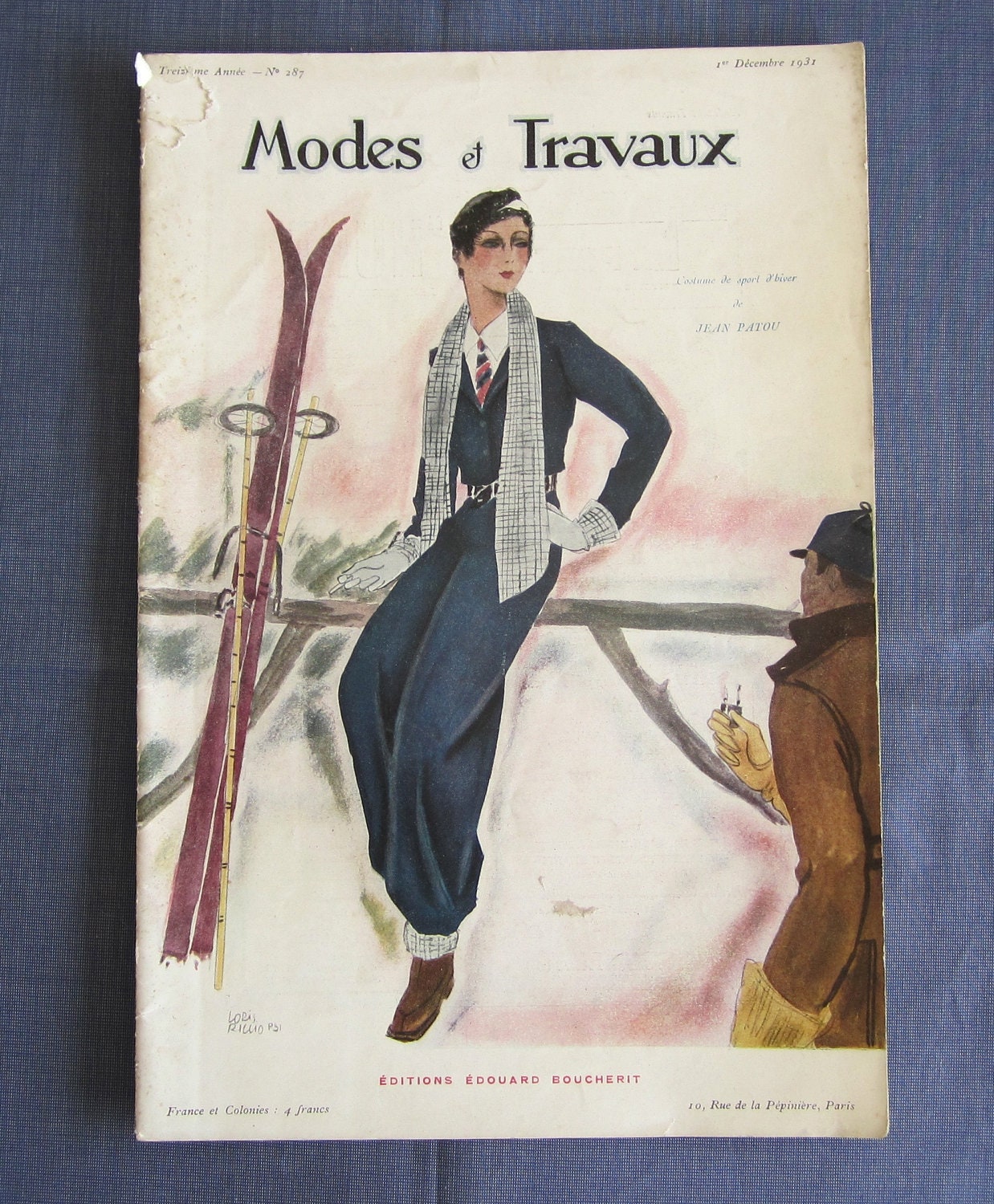
Patou is also well known for designing sportswear for women. I have a 1931 French Modes et Travaux magazine in my collection (recently added to my etsy shop because I don't have the wall space to frame them all) that features a Jean Patou ski outfit on the cover.


How about you? Do you think that this amazing little piece of sewing pattern history was worth the price tag?

Tuesday, October 9, 2012

New This Week...

 With the advent of chilly weather I've had warm wool coats and dresses on my mind. I got back to work on my vintage French draft-at-home patterns and here is the first batch of warm and toasty winter wear!


 #1735 Dress and Coat: The dress features a long sleeve and a simple neckline with cutout front details. The raglan sleeve box coat is finished with a right draped collar that becomes a scarf at one end.

 #1735 Day Dress: The dress features a darted sleeve, a square neckline with panel front details, two-piece cuffs, and an inverted pleat skirt.


#1117 Dress with lapel Collar: The 3/4 length dress features a slim, long sleeve with cuff and button trim. The skirt is shaped to form pockets in an overlapped seam and the dress is trimmed with contrast revers and collar.
 

 #1081 Bouffant- Sleeve Coat: The full-length coat features a fur trimmed collar ( the old pattern suggested nutria, a rodent similar to the beaver, but synthetic would work great!), puffed sleeves that end in a cuff, flap pockets and a self belt.


#1107 Side Button Coat: The full-length coat features a fur trimmed cravat (you can use real or faux), cuffed sleeves, a small cape at back shoulders and a self fabric belt.


And last but not least, and my absolute favorite.
#1119 Autumn Coat: The full-length coat features a fox trimmed collar, wide stitched lapels, a two-piece sleeve with cuff, and a self or suede belt.

For those who either can't afford fox fur trim (it can be rather pricey, not mention guilt inducing) there's a great synthetic alternative found in nearly every color at Fabric Depot.

Sunday, October 7, 2012

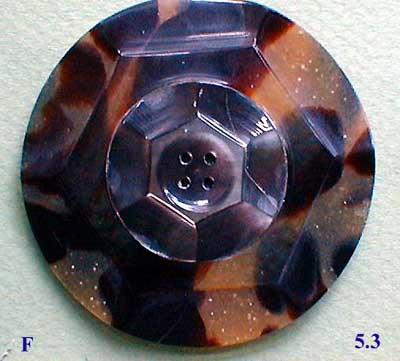
Buttons of Galalith

Recently I was translating the description of one of my lovely vintage 'draft at home' patterns when I cam across a very unfamiliar word.
 Galalithe. The pattern called for the revers and cuffs of the dress to be trimmed with "Boutons en galalithe".
Huh?


 It wasn't in my 30 lb. French dictionary so I googled at and low and behold, what did I find?
Buttons galore!
http://www.schoenlaub-galalith.com/fr/galalithe.htm

Galalith buttons from an online collection: http://boutonsweb.fr/collectionboutons/Galalithe.html

Galalith was created in 1889 when French chemist J.C. Trillat discovered the means to make casein (found in milk) insoluble by immersing it in formaldehyde. It was named Galithe (in the French)  from the Greek words for milk and stone.


It was very inexpensive to produce and soon became very popular in the fashion industry. It was produced into buttons, combs, buckles and fake jewels. It reached it's height of popularity in the 1930's and was even used to manufacture decorative handles for umbrellas.


 With the end of World War 2 came better and less expensive plastic production techniques and Galalith was relegated to the past along with its sister compounds Bakelite and Celluloid.

For those button collectors out there, according to an Ebay guide, it is said that Galalith (or French Bakelite) has a "wet wool" smell when it is run under hot water.

For those of you who want to know about the dress (I always ask, "But what about the dress?" ) the pattern is now available for download and looks like this!

Mrs. Depew Vintage
Ooh la la!

Sunday, September 30, 2012

Lingerie from 1926... pretty, pretty lingerie.


 Since my printer is on strike (pretty much a nightmare of epic proportions when you're in the business of designing printable patterns for a living...) I have been working on digitizing my truly lovely collection of Fashion Service seasonal sewing books.


The Fashion Service books were provided both as a monthly magazine and as a quarterly review that often gave enough information for an experienced home seamstress to create an entire seasonal wardrobe. They are quite hard to find and simply tickle me pink with their beautiful contents.

I thought I would share a page with you that I particularly enjoyed from Fashion Service Magazine, Autumn of 1926.


The Fashion Service Quarterly Magazines usually featured around 50 pages of beautiful pictures and tutorials. Each fashion pictured is usually described in great detail with instructions on how to make it either from scratch or by altering a basic pattern.
These lingerie drawings are no exception and the descriptions given can help an experienced seamstress create her own version.

Aren't they pretty? It's so fun to read the descriptions and imagine the fabrics used, "Sea-green French voile is pin-tucked..." and "flesh crepe de chine with turquoise blue and orchid bindings..." Swoon.

This Fashion Service magazine is now available in its entirety for instant download at Mrsdepew.com.

Saturday, September 29, 2012

An update to my Simplicity S-Series Collection


Hello lovely readers and happy weekend! I have spent the entire afternoon updating my previous post on the Simplicity S-Series sewing patterns. I found out some new ones, added some new ones to my collection, and took some photos!


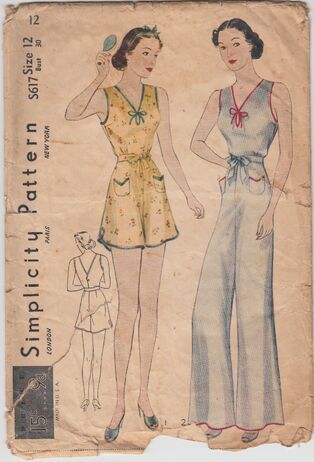
I currently have S601, S602, S604, S606, S610, S611, S613, S614, S615, S616, S617, S618, S620, S621, S622, and S623. (updated as of May 29, 2013.)


The most recent addition to the collection is S617, a lovely little step-in pajama pattern.


The S-series included a handful of patterns for children and men as well.  I have been debating whether or not to include them in my collection as I find them and I finally decided that a complete set was the only thing I could tolerate.

If in the future you come across any S-Series patterns and want to let me know, you can email me at afewthreadsloose@gmail.com. I'm also quite interested in any Simplicity Fashion Forecast flyers or ads that might help me give an exact date to any of these.
(I'm still searching for S603, S607, S608, and a complete S612.)

A few of you have contacted me when you have seen some of these come up for sale and I owe much of my success in finding them to you, so thank you!

Update: A Reproduction of S617 is now available in multiple sizes, in a paper version!

Monday, September 24, 2012

How to Make a Hot/ Cold Pack

It would appear that disaster follows me wherever I go. Allow me to expound on that. I am accident prone in the extreme. During my visit to see my mother in Nebraska, I had all sorts of plans to stay fit and not gain any weight from the many hamburgers and grilled cheese sandwiches I planned on consuming. I had recently gotten up to running two miles several times per week and set out on a run to maintain my fitness levels when my luck once again caught up with me. Sprinting at my top speed, I managed to find one of the many uneven bits of sidewalk that cunningly lies in wait looking to snag unwary passers-by. I struck the sidewalk so fast that for a moment I was convinced that I had somehow been hit by one of the four cars that drives through the small town per day. Lucky me, I hadn't and limped home with two badly skinned knees (one to the bone) a skinned palm, and I later found out, four bruised ribs.


Ouch. To the rescue flew my excellent mother and as per the doctor's suggestions I was constantly anointed (drowned) in Lavender oil (great for fighting swelling and infection) and packed in ice. My mother used a wonderful home remedy that I'm rather fond of. This "ice pack" is a soft cotton bag filled with wheat grains and holds cold very well while contouring comfortably to whatever anatomy is ailing.


After 3 minutes in the microwave it is also the most fool-proof remedy for cramps I have ever tried. Having found it so useful throughout my life, I thought I would pass along how to make one.

You will need:
2 squares of cotton fabric (mine measured 9" x 15", you can make it any size you desire).
2 1/2 lbs of wheat grains/ berries.
This is the perfect size to cover one's stomach, rest atop one's head, and warm one's feat respectively.

I have chosen to make mine with 3 channels as you see above. You can also make them without the channels but they do help the bag contour to the body.


Place your two cotton squares right sides together and pin. Your fabric must be pure cotton. Any poly blends may melt or catch fire in your microwave.


 Leave one end open for turning and filling. If you choose to make the channeled version, leave one entire end open. If you choose to make simple bag, leave only a 2" gap.

A 2" gap for filling an un-channeled bag.


Stitch, back-stitching at your open end to secure your threads. Clip your corners.


Turn the bag right side out and press. To make sure my corners turn crisply, I use the blunted tip of my sewing scissors to push them out.


 Now measure two channels and mark them on the outside. These are each 2 1/2" from the outside edge and stop 1" from the narrow ends.


Sew along your marked channels, stitching in place to secure them at each end.


Now you're ready to fill your bag! Mine took about 2 1/2 lbs of wheat and I didn't fill it completely full. For best results, fill the bag about 4/5 full and then slip stitch to close your opening.


Voila!

Now you have a nifty home remedy that makes a great ice pack or hot pad! I'll be using mine a lot this winter to warm my side of the bed before I get in!

Note: Test your bag carefully if you choose to microwave it. Microwaves vary. My mother has a very strong one and 3 minutes on high was more than enough to get it piping hot. My crappy overseas military issue energy efficient microwave takes much longer.

Wednesday, September 12, 2012

Sew Expensive... the pattern of a lifetime.


 I know the posting has been almost non-existent the last week or so. That's because I have been on hiatus, visiting my most excellent mother in Nebraska. We have had a fun week so far of hunting at garage sales and thrift shops for treasure.
One amusing past-time that I recently shared with my mother is stalking Ebay auctions for patterns that I can't afford.
And last night I watched a pattern sell for a literally unbelievable sum.
Allow me to introduce McCall 1794.


This hat pattern makes my eyes water I love it so much. I knew the moment that I saw it that the mere $150 that I was planning on bidding would be nowhere near enough. I have never in my days seen a sewing pattern for a hat of this style.

But, of course, I'm getting ahead of myself. You want to know what the pattern sold for, don't you?
This rare beauty sold last night for a staggering $685.00.
No, that's not a typo. You really are seeing a pattern sell for more than $600.

My mother was stunned. With all of her experience in the antiques world she was at a loss for why it was worth so much and asked me what I thought.

It is difficult to explain. I always say that any vintage pattern is worth what you are willing to pay for it. And clearly it was valuable enough for at least two collectors to bid over $600 each... one person's high bid may have even been in the $700 range.

(On a side note, my mother has never sold an actual hat from this era in all it's original glory for more than $400.)


But why? What is the appeal? We have already discussed the factor the the more beautiful the art on the envelope, the more us collectors drool over it. Another important factor is the hat style itself.
This pattern is dated at 1931 and features a hat style that was only popular for a few years. The close fitting cloche of the 1920's gave way to the soft brim at the end of that decade. Women who couldn't afford regular trips the milliner's sewed new brims onto their existing cloches to stay in vogue.
The fact the a pattern exists for such a short-lived hat is wonderful... we may never see another one like this again, so short is the time it had to be known.

But who would have the budget to buy such a rare gem? A collector, maybe, with a wonderful budget? That is a possibility for sure. Or perhaps someone willing to invest that much in the pattern in order to make a reproduction from it? Maybe. The most likely buyer of this pattern though will probably be a professional costumer for movies or theater. My mother used to work with the very best in the business, helping them procure beautiful clothing, accessories and jewelry for period pieces such as Titanic, The Adams Family, Amistad, and Legends of the Fall (my all-time favorite). It is no stretch of the imagination that they would be willing to pay such a Hollywood price to make near authentic copies for movies.
My hope is that the buyer was someone planning to reproduce the pattern because I don't know about you, but I plan on bringing this hat back into style again!