Showing posts with label pattern drafting. Show all posts

Sunday, November 1, 2020

The New Perfection Tailor System of Cutting from 1901


Today I thought we could continue our study of antique tailor systems with The New Perfection Tailor System - by far the prettiest and most artistically appealing system I have yet had the privilege of studying.

This bodice & Skirt tailoring system is from 1901 and was manufactured by W.R. Williams of Lawrence, KS. Instructions are printed on the pieces for drafting and there is also an instruction booklet.

The system is complete when it contains a printed envelope, booklet, Bodice Front Rule, Side Form Rule, Bodice Back Rule, Dart Rule, Sleeve (designed to draft a two-piece sleeve), Skirt Guide, and Collar and Neck Rule.
This piece is more unusual in my collecting experience because it comes with a collar and neckband rule.

The text printed on the bodice piece says "Perfected March 10th, 1879" and then has several "Improved" dates (to allow for changing styles) after the fact until 1901.

As the shape of a bodice changed considerably between 1879 and 1901, the changes and improvements were quite necessary to stay with the current fashion.

The original is printed on fiberboard with perforations for the varying sizes, which include children's 20-26" bust, and women's 28-48" bust.

Using the skirt rule and drafting booklet, several skirt variations may be made to nearly any size.


This system fascinated me to no end, and of course, because of that, I was quite driven to make sure that it survives for the next generation to enjoy. It has taken long nights, weekends, and time that I definitely should have been weeding my overgrown garden, but I have finally created a complete reproduction of the system in both pdf and printed versions.

Furthermore, feeling that the original instruction book could benefit from some added context, I added more content from my collection of Delineator and Designer magazines from 1900-1901.

If even one of you, my dear readers, find some use for this set, it will have been completely worth the time spent making it possible.

Happy sewing!

Monday, June 27, 2016

What Constitutes a Sewing Pattern... with Freebies!

Hello my dears. Today I would like to opine a bit about sewing patterns (quelle surprise!). Seriously though, I feel like many of us are missing out on the wide variety of sewing pattern types that history has given us, so here is a bit of a Sewing Pattern types TUTORIAL. A pattern is defined as "a model or design used as a guide in needlework and other crafts". These designs might not always be what you'd expect when you read the word PATTERN.


Standard: We're all familiar with a standard sewing pattern. By this I mean a full-sized, cut it out, and lay on your fabric pattern. These were made popular by the big 4 pattern companies over the last 100 or so years but they have become so standard that many have never heard of other types of patterns at all. 

For example, this  reproduction of an original 1920s McCall's pattern:


But what other types of patterns were available throughout history to the average seamstress?

Tuesday, October 14, 2014

How to Draft a Trousers Pattern - A Tutorial


Hello my dear readers,
This month I have really had trousers on my mind. A trip to Banana Republic where everything was lovely, expensive, and way too short for my long legs had me thinking, "I can make this! Why would I pay $100 for something that just won't quite fit right?"

I always do this. I call it the seamless loop. I want a garment, but it's expensive and I could make it if only I could make the time, which gets me thinking about how much my time is worth, how busy I am, and that I technically make enough money to treat myself to a lovely thing like that once in a blue moon. But I just can't justify buying it, knowing that I could make a better-fitting one... and it all goes through my mind for long enough that I get sick of it all and before I know it, I'm cranky, frustrated, and without either a purchased or handmade version of what I wanted in the first place. Have you ever done this? It sucks!
So I decided to break the cycle. I am drafting a few patterns to test out the fit, length, waist rise etc. until I have the perfect pair. 


I also decided that I would create a tutorial here in case any of you might like to try trouser drafting for yourselves!
Here's what you'll need:

Paper, long enough for your high waist to floor measurement plus a few inches more, and wide enough for 1/2 your hip measurement plus a few more inches. (a nice, 36" wide roll does nicely!)
Pencil,
Eraser,
Rulers, including yardstick or a tailors' square if you can get one.
A French curve, hip curve or other curve drafting tool.

And of course, you'll need your measurements! This tutorial is adapted from a 1940's/ 1950's trouser so you'll want to pay attention to your vintage sizing.


And now for how it's done!


I. - See illustration above.

A to B - Equals side length measurement.
A to C - Equals 6 3/4” for size 12
              6 7/8” for size 14
              7” for size 16 and up...

C to D - Equals 1/4 of hip measurement plus 3/4” for ease. Square this line across at C.
C to E - Same length as C to D. Extend line D-C to E; then pivoting at D, draw an arc line above E.
A to F - Equals crotch depth measurement plus 1” for ease. Mark point F on line A-B.
G to H - Equals hip line D-E. Draw this line through F, parallel to hip line D-E.
G to I - Square this line up at G through D, making this line 1/2” less than A to F.
H to J - Equals 1/2 of line F to H. Extend line G-H to J.
H to K - Equals 1/2 of line H to J.
K to L - Equals line G-I (center front) plus 2” for center back line. Draw this line from K to L, touching the outer most curve of arc line.
G to M - Equals length from K to J.
G to N - Equals 1 1/2”. Draw a diagonal line; then draw a curved line from D to M through N.
K to O - Equals 1 1/4”. Draw a curved line through O.
G to P - Equals length of F to B. Square a line down at G.
K to Q - Equals length of F to B. Square a line down at K.
P to Q - Connect for lower edge.
P to R - Equals 1/2 of line P to D.
R to S - Square a line across at R for knee line; then draw slightly curved lines from M to R and J to S for inner leg seam.
B to T - Equals 1”.
T to C - Connect.


II. - See illustration above.
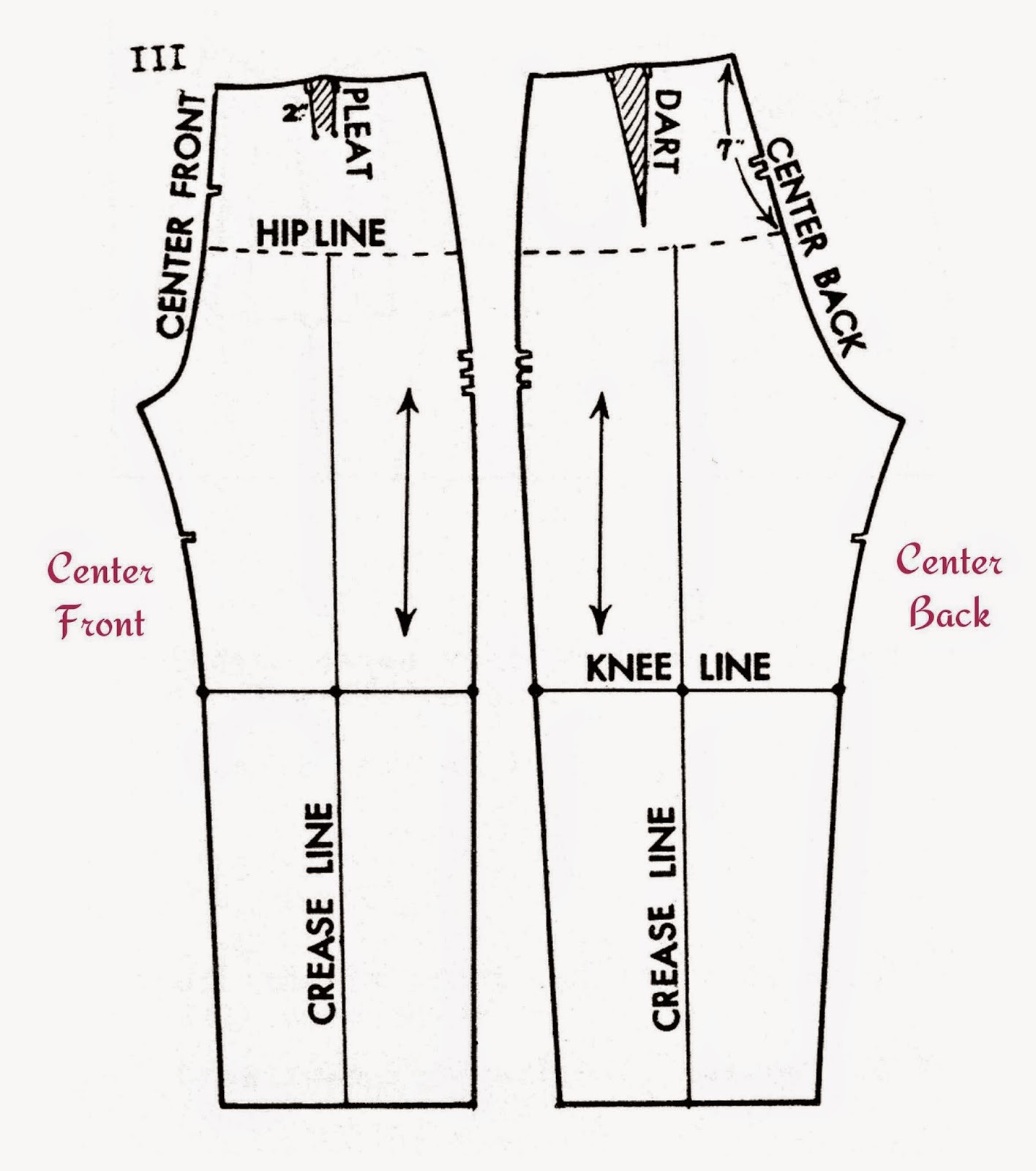
Draw waistline slightly curved, from I to A to L. Reduce waistline to fit 1/2 of waist measure. First make part of reduction at sides and center front. Then make a dart in back and a pleat in front at follows:
C to U - Equals 1/2 of C to E.
L to V - Equals 1/2 of back waistline; then draw a V-shaped dart, 6” long.
D to W - Equals 1/2 of D to C.


III. - See illustration above.
For crease lines on front and back, divide the knee and lower lines in half; then draw crease lines from bottom to hip line. For waistband, make a double band 1 1/2” wide, finished and the length of the waist measure plus 3/4” extension for left side opening. To complete pattern, add seam allowances to all pattern pieces and hem allowance to trouser bottoms. Make corresponding notches.


And there you have it! The straight waistband should only be used if you draft your pattern at waist level. If you lower it closer to your hip line, you'll need to draft a curved waistband.

Aaaaand on a completely separate note, I have decided to have a sale this week at Mrs. Depew Vintage! If there is a pattern you've been eying, now is the time to try it. Use coupon code "FLUFFEHKITTEH " in the box at checkout for a 15% discount - good until the 21st of October.

Happy sewing!


Saturday, July 26, 2014

Sewing #610... Drafting your pattern.


Hello lovely readers,  I'm so glad to hear that a few of you will be following along with me for our mini sew-along!

The pattern we're using is what I call a draft-at-home pattern. It means that you have a very small pattern with a series of numbers on it, and it is enlarged to your measurements using the measuring bands/ special rulers that come with it.

My pattern and measuring band, ready to be drafted to my size.

To draft your pattern, you can use the instructions included along with your pattern, or you can see how it's done in this photo tutorial. Please don't be intimidated by this, it will only take you a few minutes to draw out your pattern!

You can also check out my draft-at-home pattern F.A.Q. page if you need any quick answers while working with  your pattern.

Below I have my drafted pattern using the 92 cm band. This is my full over-bust measurement in centimeters.

Here is my pattern before I have connected the dots.
I am using a French curve to draw out my more rounded lines.

Once your pattern has been drafted, you'll want to do a few things to ensure that you have a good fit and an easier time sewing.

First, you want to make sure that your dart legs are the same length.

Measuring my dart legs.
If your dart legs are different lengths, measure down from the tip of the dart along the dart leg and mark the difference. If you have a difference, you'll want to divide that difference out between the two dart legs equally. (Example: if dart leg A measures 3" and dart leg B measures 3 1/4", then your difference is 1/4" and you will add 1/8" to dart leg A and shorten dart leg B by 1/8".

Adding the difference to one of my dart legs.
This is called truing your darts.

Re-drawing the curved line from my added dart let length to smooth it out.
It is also be a good idea to measure your dart intake (the distance between your dart legs) in case you need to make more adjustments later.
Once you've checked out your darts, you're almost ready to cut out your pattern. This pattern has a seam allowance included but you need to make sure that your darts have an allowance too. (You know how your darts are often slightly peaked at the pattern's edge? We need to make sure ours do that too.) This is easy, don't worry.

My bra pattern drafted out and my dart legs trued.
Starting with one of your darts, fold the pattern in half horizontally so that the tip of the dart is right on the fold line.
Folding your paper again along the dart leg closest to the center back, fold the dart leg over towards the other dart leg.
A horizontal fold with the dart tip at the fold.

Once your dart has been folded, it will resemble how it is to be sewn.
Pin both of your darts closed and then cut out the pattern. If your dart legs are trued properly, they should match perfectly when folded together. If not, you can just re-true them before cutting out, while the dart is still folded.

My pattern cut out, while the darts are still closed.

Now your darts automatically have those nice little peaks that will allow your dart to rest properly on your bust. Without doing this, it can make your darts pull and can cause some annoying fit issues.

At this point, it's a good idea to determine what manner of back closure you're using - if you want to simply add hooks and eyes instead of a French or purchased closure, you need to measure and make sure that the bra back reaches far enough for your needs before cutting it out. Or, you can always just tape an extension onto the back of the pattern piece if you need more room. 

It's also a good idea to put a tiny notch in the upper back end of the pattern. This can come in handy during test fitting, to help you tell top from bottom!

Cut one, center front on the fold.

Now your pattern is ready to be cut out of your muslin or practice fabric to be tested on yourself!

Any questions?

Happy sewing,