Showing posts with label lingerie sew along. Show all posts

Saturday, November 7, 2015

1940's Bra Sew-Along - How to face pattern pieces and lining options.


Happy weekend, sewers! Ready to do some more bra sewing?

In our last post we talked about adjusting our cups sizes. Since I haven't gotten any more fitting questions from you, we're ready to move on.
Today we need to talk about lining options. What should the inside of our bra look like? Well, there are three methods of lining I have used in bra sewing in the past and one is far superior to the others.
The first is fully lining the bra. As I did with my bra #2001 for the Oooh la la Pin Up Sew-Along, you sew two complete bras (minus straps and closures), one of lining and one of outer fabric. Then you sew those two pieces right sides together all along the bottom seam and then bind the top edge. You can also sew the entire bra together at top, bottom and edges, leaving a gap to and turn the bra right side out. This conceals all of your raw seam edges. This can lead to some of your seams shifting a bit and if you have thin fabric, seam edge shadows can show up all over the place.

From a 1940's Brassiere in Profile - the edges here have been turned under and stitched, or faced with a piece of cotton tape.
Another technique is to sew one bra without lining, but of at least medium-weight fabric, and simply bind or turn the raw edges under as done in the bra above. By far though, I prefer to face my pattern pieces and use top stitching and rayon or cotton tape to finish my edges. This is the closest I can get to a historically accurate bra from the 1940's without hunting down some cotton-backed satin (seriously, it's hard to find!).

So to do this, simply cut the entire bra out from your outer fabric (I'm using white satin from our kit), and another entire bra from your lining fabric - I like fine cotton lawn or muslin for this.

Pieces C in satin and cotton, ready to be pinned.
Lay the lining pieces wrong sides together onto your outer (satin) pieces and pin them securely in place. You'll want your right sides to the exterior for this step.

All pattern pieces in cotton and satin, pinned wrong sides together.
Carefully baste each set of pieces together only along the top and bottom edges about 1/8" from the edge.


You will want to leave the left and right edges (side seam, center front and center back edges on all pieces) un-basted. If they are basted at all edges, this can lead to some creases and bunching that won't sit well on the sewn bra.

--Update: This method is a good one to use if your fabrics aren't prone to fraying. The satin I'm using doesn't fray very much so I'm comfortable with having a trimmed, top-stitched, but unconcealed raw edge inside my bra. If you want a more finished appearance on the inside, then you can either fully line the bra as mentioned above (instead of just facing your pieces) or you can finish the raw edges of each seam with either a serger or an edge stitch (a blanket stitch was very common on curved bra seams in the 1940's).

Here is the interior of my bra using the facing/ top-stitching method.

And now you're ready to sew your actual bra together!
Any questions about lining, facing or binding?

Happy sewing,


Monday, November 2, 2015

1940's Bra Sew-Along - Adjusting Bra Cups


It's time to talk about the bra cups! At this point you'll have chosen your size and sewn your muslin (don't worry, no deadline! I'm just posting this now per request). Some of you will find that the bra fits pretty well on the first try (lucky you!).

Here is how the pieces are meant to rest on your figure.

Others will find that they need more or less room in the cup area. That means we need to make adjustments to the seam between pieces A and B.


Above is the seam we're looking at highlighted in blue. For reference, the top of piece A should be about 7" from where a shoulder seam would sit on a t-shirt. The pattern doesn't use cups sizes, as we discussed earlier, but that doesn't mean we can't make cup adjustments. For our purposes, it's a good idea to only adjust cup size one size at a time. This pattern is approximately a B cup depth-wise, and the increase (or decrease) rate is 1/2" per cup.
Warning: adjusting the cups beyond a DD can really change the shape of the bra and it might not look the same after. I'm talking about uni-boob, a very real threat.

This is how you will need to add or subtract allowance from the seam:


Due to the shape of these pattern pieces, I recommend adding the brunt of your changes to the seam on piece B. First trace your pattern pieces onto a new sheet of paper (leave some room around them to make adjustments. To increase the cup size, add 3/8" to uppermost curve on piece B. Add 1/8" to piece A. This will equal 1/2" in total.

Note: If your girls tend to rest more to the side than front and center (some of us carry more fullness an inch or two nearer to the side), then you can shift the added bit to sit closer to your fullest point.

From this added bit, you'll want to smooth the new line to nothing until it blends to touch the side and center front seams at the ends, as illustrated above.
As you add this change, you want to make sure that the seam edges on the left of this diagram stay the same height. These still need to match up to piece D later on.


Now, by adding allowance to this seam, you're actually lengthening the seam line and piece B won't quite match piece A any more. This can be fixed by walking the pattern pieces together to match them up. Measure the difference between the pattern pieces and then add the difference to piece A as illustrated above in pink. If you make any changes to the sides of piece B, keep in mind that it still needs to match up with piece C.

Do the same to remove too much room at the cup seam by subtracting rather than adding the 1/2".

And just like that, you've adjusted your cups! Now it's time to test it again in muslin to see if that sucker fits better.

Happy sewing,


Thursday, March 8, 2012

Ohh La La Pin Up Sew Along... Attaching your garter clips.


The pattern we're using...

Yesterday Sarah taught us how to make lovely covered garter straps and now that my clips have arrived and I've gotten 3 hours of sleep, here's another way to attach them.
(3 hours of sleep is a small victory, by the way, I'm not complaining :)

My lovely pink vintage garter clips.
I have in my sewing stash some really soft, plush lingerie elastic in a metallic sort of cream color that coordinates nicely with my bias binding. This will be perfect for making my straps into stretchy loops.


The first thing you want to do is try your corset on with your favorite pair of stockings to see how long your clips should be.

Wednesday, March 7, 2012

Ooh la la Pin Up Sew-Along... Optional Detail - Satin Covered Garter Straps


It's garter clip time! Sarah just posted the greatest tutorial at Ohh Lulu in sewing a satin covered garter strap.

Hers came out beautifully, don't you think? Even if you don't plan on using this technique, the post is great reading with lots of pretty pictures featuring Sarah's gorgeous corset.

My husband brought the mail home with him this evening (our mail comes to the base) and there were boxes and envelopes overflowing with the many lingerie sewing accoutrements I've been snapping up lately, my much awaited garter clips included!


I haven't had a chance to sew on these lovely little pink bits but I'll get a post up tomorrow with the finished product. I'll be using cream plush lingerie elastic to attach my garters. Has anyone had any trouble finding garter clips or any of your other notions?

Monday, March 5, 2012

Ooh la la Pin Up Sew-Along... Binding your edges.


The pattern we're using...

Today for binding your edges, Sarah put together an excellent post for us. Her explanations are so nicely put together that there's not much for me to add! Her method is a really great way to control the quality of the binding that goes on. There are so many ways to bias bind an edge that we really don't want to overwhelm you with too much info here. I prefer to sew mine on completely by hand because crazy, unnecessary hand work soothes the neurotic person in me. You really don't have to do it that way.

~Sarah~

Before you get started, make sure you have inserted all of the bones you plan on using, and have tested the fit.
For your binding, you can use purchased bias trim or bias trim made of self or contrasting fabric.  I'm using the same pink satin as I used to cover my bone casings.  I am cutting bias strips 1 1/8" wide, and pressing my folds prior to stitching.

Baste your bias tape in place, leaving a little overhang on each end as pictured above.

Tuesday, February 21, 2012

And The winner is...

Hello lovely readers. I'm about to make some eggs Benedict with fresh avocado and tomatoes for supper but first I'm going to announce the lucky winner of the Ooh La La Pin-Up Sew-Along Giveaway!


We had 112 comments from you all and as chosen by Random.org, the winner is #94, Tina Cosgrove of Down The Retro Rabbit Hole!
Tina, you can email your contact info to me at afewthreadsloose@gmail.com.

Tina wins the entire Sew-Along Kit which includes the Corset Garter belt pattern, the matching Bra pattern, and a copy of Pretty Pretties" a 1940's lingerie sewing handbook.

Thanks to all of you who entered the giveaway and who are joining Sarah and I for the sew-along!
We'll both post more tomorrow on the importance of making a muslin of the corset pattern.

Ooh la la Pin Up Sew-Along... Corset boning and why you need it.

 
When to Use Boning, and What Kind
The question is, are you wearing it to the bedroom or the boardroom?
Boning your corset is always best, to be honest. In my experience, unless it’s hiding under a dress, bedroom lingerie has a shelf life of about 2.5 minutes before it lands on the floor. That 2.5 minutes doesn’t require too much support. The main point of the side boning in this corset is to keep it from folding and bunching up on you when you bend over.
(I’m sorry, I’m immature, and I’m giggling at all the double entendres as I write this.)

There are several kinds of boning that you can use both new and vintage.


Vintage Notions:
My mother, the fantastic vintage dealer and former custom corset-maker literally has buildings full of vintage clothing, patterns, ribbon, fabric, notions and a million other things. Last summer on a visit home she and I dug through boxes and boxes and I stumbled across more than one large box that was overflowing with old bias tape, rick rack, needles, ribbons, spools of thread, and to my delight, a box of Warren’s Featherbone.


Needless to say, I bought an extra suitcase to drag the contents of the box home with me.


Thursday, November 3, 2011

Lingerie Sew-Along: Tap Panties Finishing Touches Part 11!

I'm ba-ack. Well, to finish my vacation off nicely I had a horrible cold the whole time, and now that we're back and my husband is even more sick than I was, and we've added jet lag and no sleep to the mix? I'm stiiiiiiiiiiiiiiiillllll sick. Ugh.

I really hate leaving you all hanging though, and I'm heavily dosed up with cold medicine right now, so LET"S DO THIS!
There are a few different ways you can finish your inside facings. You can serge the edges and tack them by hand onto the seam allowance, pink them and leave them loose, douse them in vodka and set them on fire, but my favorite is to tape them down. Not the scotch tape way, of course, but the fusible kind like this Dritz Stitch Witchery.


You can use it to fuse two layers of fabric together, or to finish raw edges with seam tape.


Here I have laid down a strip of the (shinny) fusible tape. Next I just stick the (very pretty) vintage rayon seam tape over top and a quick press with the iron makes it permanent.


Wednesday, October 26, 2011

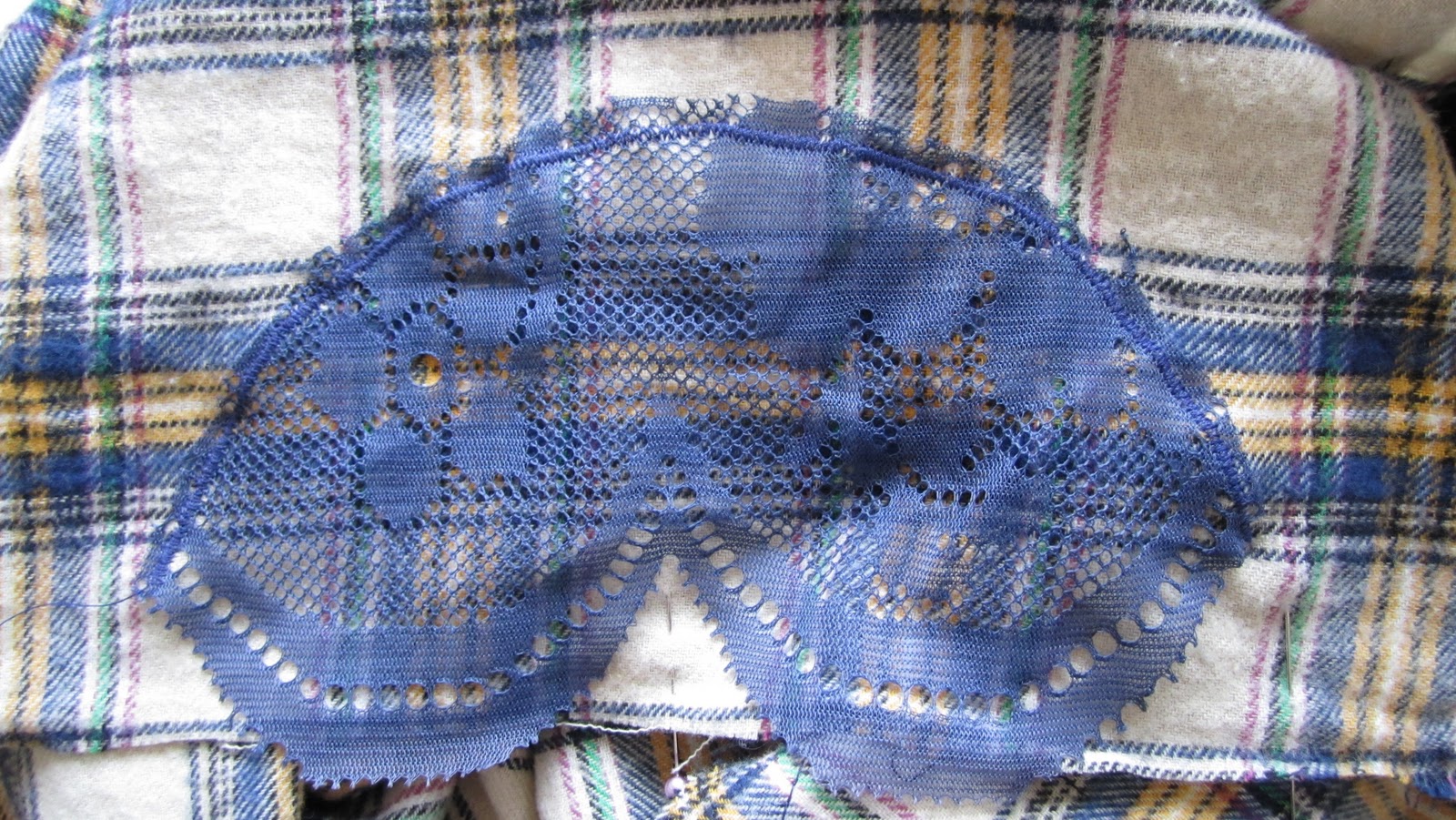
Lingerie Sew-Along: Tap Pants Lace Inset and Front/ Back Facings, Part 10

Today we're going to go over the lace inset, and the front and back facings.


In the first post on the tap pants, we traced out a pattern piece for the lace inset. (Before you add any extra to the size of the pattern).


It might come in handy to fold the inset pattern piece in half so that you have a crease guiding you to the center of the inset.

I am using a vintage lace trim several inches wide. The source of the lace? My awesome mother!  Your steps may be different depending on what type of lace you use. What I did above was just center the inset pattern piece over the two scallops so that I could cut my trim at the right point. Then I cut two lengths of the lace, one for each leg.


I have marked the very center of the spot where I'll be laying in my inset on the RIGHT side of the tap pants leg. Since I have chosen to use a scallop- edged lace, I will line up the center point of my two scallops with the pin.

lace inset being set up on the RIGHT side of the pantie leg.
First I lined the scallops in the lace up with my pin marking the center point. Then I laid the inset pattern piece over and pinned it in place to both the lace and the pantie leg. The lace should be resting on the RIGHT side of the fabric. Then I trimmed the excess lace away from the edge.


Above I have removed the pattern piece and secured the lace again to the pantie leg. Now comes the fun part.

In Pretty Pretties, the lace is hand stitched carefully to the RIGHT side of the fabric. Luckily, we have something better now than hand stitching for lace insets. Its called an Applique Stitch and it's our friend! Most machines should have this stitch, and you can look in your manual to find it if you're not sure.

On my Brother machine, my applique stitch is #24. If you don't have an applique stitch on your machine, just use a zigzag stitch. After much experimenting I discovered that the best applique stitch for me is 3 mm wide and 0.5 mm between each stitch.


With your lace very securely pinned in place, stitch all the way from one end of the curve to the other, about 1/4" from the edge of the lace. Sewing a bit back from the edge gives your applique stitch as much grip on the lace as possible to keep it safely attached.


Now trim the excess lace from the outside of the stitching, being careful not to clip your stitches.


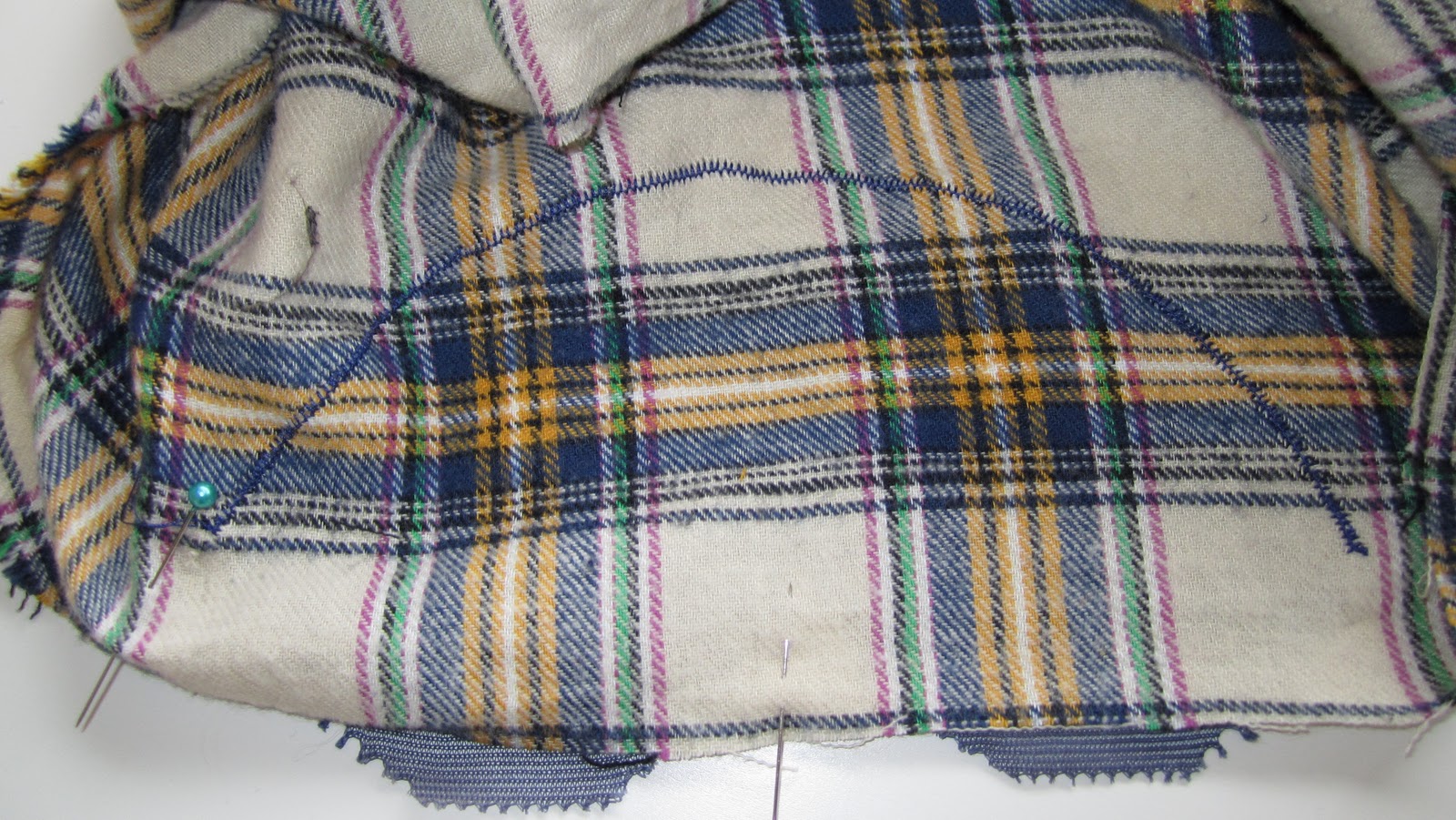
Your inset stitching from the WRONG side.
Now we need to get rid of the fabric behind the lace. From the RIGHT side of the fabric, flip the lace back to expose the pantie fabric. Trim the fabric away from inside the circle, trimming very close to the stitching.


Since I have a scalloped lace edge, I trimmed the edge of my fabric to a scallop too. This edge will be bound later.

The Facings:
A quick note for those of you who accidentally cut out your V of Doom from the placket opening: For your yoke facing, you'll want to extend the edge of it so it faces the edge of the extension placket I mentioned. Below is just a quick mock up of an extension I drafted to make the yoke facing piece longer.


For the yoke facing, pin it right sides together to the pantie yoke matching up the center and the edges at the placket. Stitch the facing on and press.

The Front yoke of the pantie, with the yoke faced and pressed on the other side.

Now we want to pin the back facing piece to the back of the panties, RIGHT sides together and stitch. Then flip the facing to the inside and press.


The pantie back from the RIGHT side, with the facing pressed to the inside.
The pantie facing pressed to the inside.

Next post we'll cover finishing the raw edges of the facing pieces, the placket, binding the leg, and we're done!

Lingerie Sew-Along: Inner Leg and Front to Back Seams, Part 9