Showing posts with label tutorial. Show all posts

Sunday, April 9, 2017

Making Your First Dress - A Lesson from 1927


I just keep finding things inside of my Woman's Institute lesson books! This time I was looking through Dressmaking - Perfection in Details and this flyer was tucked in the back.
It was most likely included in the mail order coursework as part of the Dressmaking Program.

It mentions a few commercial patterns that one could purchase to make these looks including Ladies' Home Journal 5146, Butterick 1390, Butterick 1561, Pictorial Review 4006, and Ladies' Home Journal 5503.

Enjoy!


Oh, and in other news, look what I just finished!

#3069 Slip Pattern

Sunday, November 15, 2015

1940' Bra Sew-Along - Finishing with a closure.


Hello my dears. I hope you're having a lovely weekend so far.
I just want to start this post out today with a warm hug for my friends and followers in France. Your country was my first love and my oldest friend, and after the events of yesterday, you are in my thoughts and prayers.

It's a chilly day here in Monterey and the sun is at a low angle in the sky. My house smells like a house should on a cold day - hints of apple cider and a pot roast in the oven are wafting up the stairs to my studio. And it's the perfect time to type up a blog post and finish our sew-along.

In our last post we discussed edge finishing and sewing our straps in. Now all that's left to do is add our back closure and we should be done! I know we're all used to hook and eye closures in bras these days and that's what I prefer for this bra. But if you're going for a full 1940's bra style, know that you can also use buttons and loops if you like, or a French bra back, which is essentially two lengths of elastic and a hook.

For this project I have used plush-backed hook and eye tape with a double set of eyes for adjusting fit. This is pretty much plug and play, but there are a few notes on placement.

The first thing to do no matter what type of closure you use, is to stay-stitch the center back of each piece D to keep it from stretching while you work. This can be done with any straight stitch 1/8" from the edge.


Tuesday, October 14, 2014

How to Draft a Trousers Pattern - A Tutorial


Hello my dear readers,
This month I have really had trousers on my mind. A trip to Banana Republic where everything was lovely, expensive, and way too short for my long legs had me thinking, "I can make this! Why would I pay $100 for something that just won't quite fit right?"

I always do this. I call it the seamless loop. I want a garment, but it's expensive and I could make it if only I could make the time, which gets me thinking about how much my time is worth, how busy I am, and that I technically make enough money to treat myself to a lovely thing like that once in a blue moon. But I just can't justify buying it, knowing that I could make a better-fitting one... and it all goes through my mind for long enough that I get sick of it all and before I know it, I'm cranky, frustrated, and without either a purchased or handmade version of what I wanted in the first place. Have you ever done this? It sucks!
So I decided to break the cycle. I am drafting a few patterns to test out the fit, length, waist rise etc. until I have the perfect pair. 


I also decided that I would create a tutorial here in case any of you might like to try trouser drafting for yourselves!
Here's what you'll need:

Paper, long enough for your high waist to floor measurement plus a few inches more, and wide enough for 1/2 your hip measurement plus a few more inches. (a nice, 36" wide roll does nicely!)
Pencil,
Eraser,
Rulers, including yardstick or a tailors' square if you can get one.
A French curve, hip curve or other curve drafting tool.

And of course, you'll need your measurements! This tutorial is adapted from a 1940's/ 1950's trouser so you'll want to pay attention to your vintage sizing.


And now for how it's done!


I. - See illustration above.

A to B - Equals side length measurement.
A to C - Equals 6 3/4” for size 12
              6 7/8” for size 14
              7” for size 16 and up...

C to D - Equals 1/4 of hip measurement plus 3/4” for ease. Square this line across at C.
C to E - Same length as C to D. Extend line D-C to E; then pivoting at D, draw an arc line above E.
A to F - Equals crotch depth measurement plus 1” for ease. Mark point F on line A-B.
G to H - Equals hip line D-E. Draw this line through F, parallel to hip line D-E.
G to I - Square this line up at G through D, making this line 1/2” less than A to F.
H to J - Equals 1/2 of line F to H. Extend line G-H to J.
H to K - Equals 1/2 of line H to J.
K to L - Equals line G-I (center front) plus 2” for center back line. Draw this line from K to L, touching the outer most curve of arc line.
G to M - Equals length from K to J.
G to N - Equals 1 1/2”. Draw a diagonal line; then draw a curved line from D to M through N.
K to O - Equals 1 1/4”. Draw a curved line through O.
G to P - Equals length of F to B. Square a line down at G.
K to Q - Equals length of F to B. Square a line down at K.
P to Q - Connect for lower edge.
P to R - Equals 1/2 of line P to D.
R to S - Square a line across at R for knee line; then draw slightly curved lines from M to R and J to S for inner leg seam.
B to T - Equals 1”.
T to C - Connect.


II. - See illustration above.
Draw waistline slightly curved, from I to A to L. Reduce waistline to fit 1/2 of waist measure. First make part of reduction at sides and center front. Then make a dart in back and a pleat in front at follows:
C to U - Equals 1/2 of C to E.
L to V - Equals 1/2 of back waistline; then draw a V-shaped dart, 6” long.
D to W - Equals 1/2 of D to C.


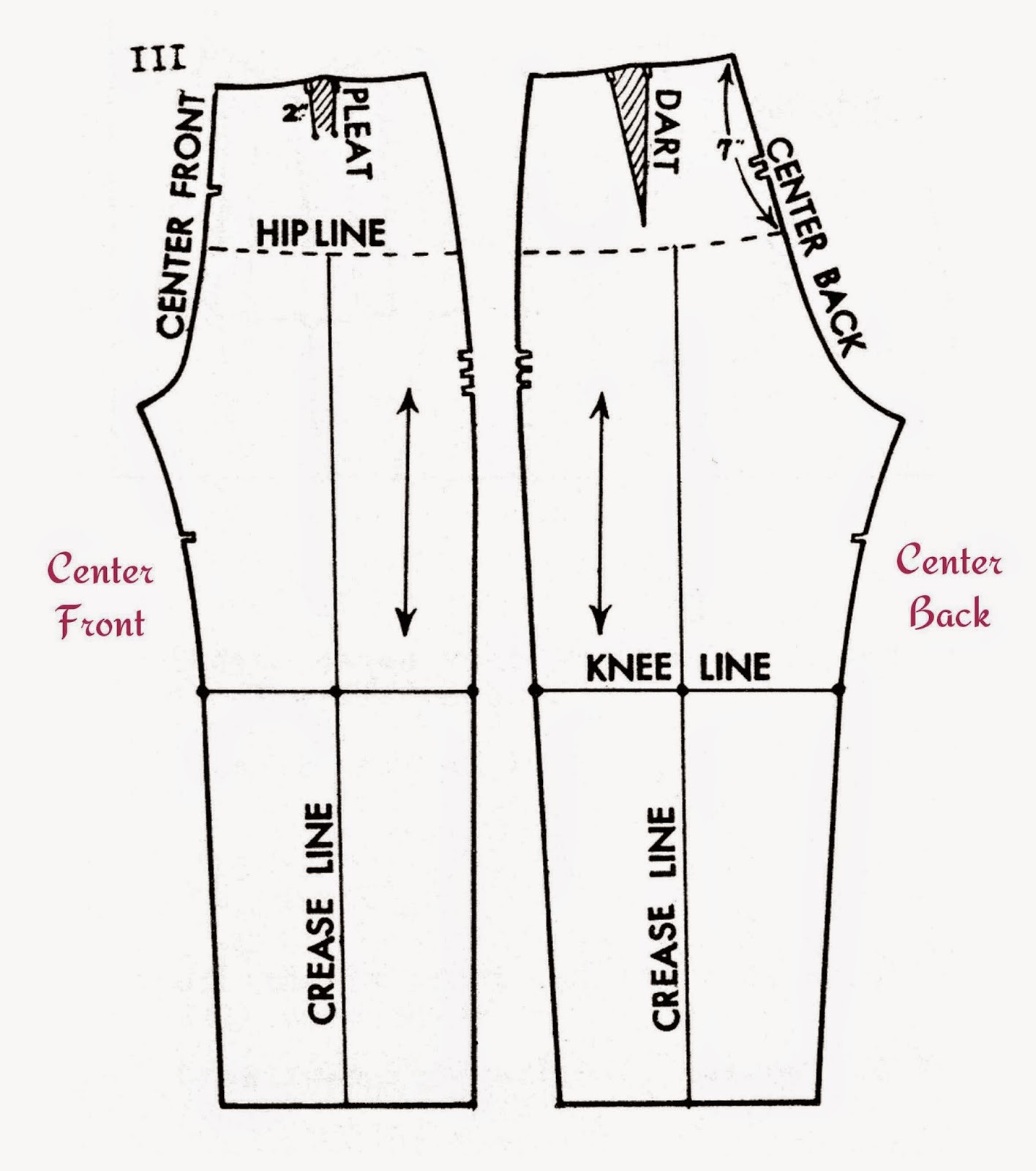
III. - See illustration above.
For crease lines on front and back, divide the knee and lower lines in half; then draw crease lines from bottom to hip line. For waistband, make a double band 1 1/2” wide, finished and the length of the waist measure plus 3/4” extension for left side opening. To complete pattern, add seam allowances to all pattern pieces and hem allowance to trouser bottoms. Make corresponding notches.


And there you have it! The straight waistband should only be used if you draft your pattern at waist level. If you lower it closer to your hip line, you'll need to draft a curved waistband.

Aaaaand on a completely separate note, I have decided to have a sale this week at Mrs. Depew Vintage! If there is a pattern you've been eying, now is the time to try it. Use coupon code "FLUFFEHKITTEH " in the box at checkout for a 15% discount - good until the 21st of October.

Happy sewing!


Tuesday, July 29, 2014

Sewing #610... Sewing the bust darts.


Aaaaand we're back with more bra sewing! At this point, we've drafted our pattern and cut out our test muslin for the bra. Don't you just love how the whole bra is just one piece of fabric? It definitely makes life easier!

I have cut out and sewn the darts in my silk version - the fabric I'm using? It's from an old set of silk charmeuse pajama pants that didn't survive my tossing and turning for long. The fabric has a bit of wear to it, but it's still pretty and feels heavenly on the skin. Waste not, want not - n'est pas?

For both your test muslin and the actual bra, you'll be sewing quite a few darts. Between my muslin, my adjusted muslin, and the bra in silk, that's 12 darts - 16 if you're lining the darn thing. So it helps to know a few things about sewing bust darts, and darts in general.


It's smart to start at the bottom and sew your way towards the tip, but here are a few more tips:
  • For bust darts, adding a very slight curve at the tip of the dart will help the garment contour better to the roundness of your bust. See more about that here.

  • At the tip of the dart, don't back-stitch, instead, pull the garment out from your sewing machine and leave a trail of threads long enough to tie a loose knot. Make sure that there are a few millimeters of ease between the knot and the dart.
My pin stealthily rusted onto my fabric, the horror!
  •  Press your darts flat before pressing them open. This will help set the stitches in the fabric.

  • And by far, my favorite tip for pressing my bust darts is to use an old bra! Fold the bra (the ones that are thickly padded are best) in half so that it supports itself and then cover it with a towel or press cloth.


The lovely little mound that it creates is vastly superior to my own pressing ham and perfect for pressing bra darts.

An old bra makes the perfect shape for pressing bra darts on.
So I've sewn my bust darts in the bra and now I'm going to take a short week-long break from sewing.

Pardon the wrinkles, I pressed the darts ok but the rest of the bra will just wrinkle again during handling, lining or binding so I don't even bother with the rest of it.
This coming weekend, I'm flying back to Nebraska to help my family manage the auction we're having to liquidate the family antique business. It was run primarily by my mother and with her now gone, none of us has the heart to continue with it. It's a very sad, but necessary part of adulthood, I suppose, letting go of the things you loved as a child. In this case, my sister and I grew up in our Mom's antique shop (home schooled and everything) and it will be awfully hard to say goodby to that chapter of our lives.
My wounds are still very raw from losing Mom only four months ago so this coming week will not be an easy thing to survive sober (though I'll be trying).

Wish me luck!


Friday, May 30, 2014

Quickie Tutorial: How to frame your embroidery.


Hello lovely readers,
Today I have a quick tutorial for any of you who might be new to embroidery: How to frame your finished projects.

For this project I used a simple 9" wooden embroidery hoop from my local craft chain, some white embroidery floss, and the embroidered design I mentioned in my last post.
Start with your finished embroidery centered in your hoop, pulled taught, and the hoop screw tightened.

For a round embroidery hoop, begin my trimming your excess fabric off around the hoop (it doesn't have to be pretty - mine sure isn't.


Cut a long piece of either very strong thread or embroidery floss (I suggest using the same color as your fabric). This piece should be as long as the circumference of your hoop and an extra few inches.


Thread it on an embroidery needle and knot one end. Then run a simple, very wide straight stitch all the way around your fabric to the outside. Mine was about an inch from the edge of the hoop, and about 3/4" long on each stitch. You want some decent spacing because you'll be gathering this stitch.


Once you've stitched all the way around, bring your thread to the right side of the fabric and gently pull your gathers tight.


Once the stitches are gathered tightly, run a couple of back stitches and then knot off your thread.

If your embroidery hoop is not very deep like mine (mine is not even 1/2" deep) then your fabric gathers might be too bulky to lie flat enough against a wall.  Simply iron your gathers flat (you might have to use just the edge of your iron) but it works great to reduce the gathered bulk.


And now your embroidery is ready to hang!


Have a happy week,

Monday, February 24, 2014

Sew in Love... A Vintage Vanity Does Halter Top Video Tutorials!


Hello lovely readers!
Recently I was delighted to find that the very talented Jennifer of A Vintage Vanity on Youtube has done a full video tutorial series on sewing Depew #1006 - one of my vintage pattern reproductions!

The "So Sew Vintage" series of 5 video posts walks you through printing and taping together the pattern, grading the pattern (if necessary) to another size using the included pattern grading instructions, mocking up a muslin and adjusting the fit, interfacing the final pattern pieces and sewing them together, and adding buttons/ buttonholes to the finished blouse.

Jennifer, a self-proclaimed Geek (geeks unite!) chose to make her halter top out of Dr. Who-themed Tardis fabric, which, in my opinion, is unsurpassed in its epic-ness. 

The posts are very in-depth and so entertainingly presented that a complete beginner would have very little trouble sewing this blouse right up!

If you're not interested in sewing this blouse for yourself, you might want to check out the "A Vintage Vanity" Youtube channel anyways for amazing vintage fashion, DIY, makeup and hair tutorials and vlogging!
You can also follow A Vintage Vanity on Facebook.

If you are interested in giving this pattern a try, below is the complete tutorial set!

Happy sewing!


Part 1: Printing and taping together your pattern.


Tip: every printer is different and occasionally marins might be a hair off. If you find while taping the pattern pages together that the lines aren't matching up perfectly, give the perimiter of the pattern piece itself a little snip to free it from the paper around it. This can make it much easier to line up the pattern lines as necessary.

Part 2: Grading the pattern pieces.


Part 3: Mocking up the sewing pattern for a test fit.


Part 4: Interfacing and sewing the pieces together.


Part 5: Adding buttons and buttonholes - and the big reveal!


A huge thanks to Jennifer for taking the time to put together such a fantastic tutorial series! I can't wait to see the next sewing project you take on!


Thursday, May 2, 2013

French Knickers Sew-Along... Embroidered Touches


Hello lovely readers. Today I want to chat a bit about finishing touches on your French Knickers... or any lingerie for that matter. Many of you know that I'm constantly inspired by my collection of vintage lingerie and lingerie patterns. My biggest source of inspiration is lingerie from the 1920's. I feel that the handwork details, fabrics used, and styles are all easily accessible to the modern seamstress.

vintage bra and panties sewing pattern from the 1920's

There are no scary under-wires, boning, and not too many elastics to worry about. The styles are so simple to sew that more time and attention can be payed to tiny details like lace applique and embroidery.

vintage 1920's embroidered camisole, lingerie embroidery
1920's Lingerie Top Via Etsy shop The Paraders.

My goal in creating my own lingerie has always been to reach a point where I can skillfully make some beautiful, new or vintage-inspired pieces of lingerie for my own enjoyment using techniques that I've learned from my exploration of vintage pieces.

Here are just a few of the amazing pieces that inspire me to keep trying:

vintage 1920's embroidered camisole, lingerie embroidery
Vintage Camisole Via Etsy shop Rococo Vintage.
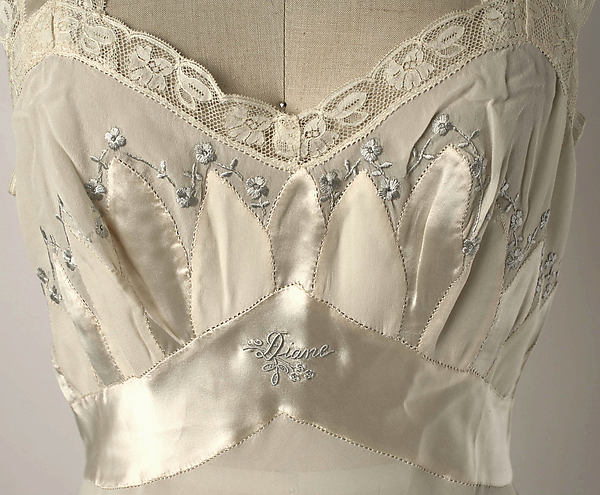
Vintage 1950's embroidered silk nightgown, lingerie embroidery
1950's Nightgown from the Metropolitan Museum of Art
Sigh... some day I'll be that good. Then I'll make something like the above and be too chicken to wear it in case I hurt it.

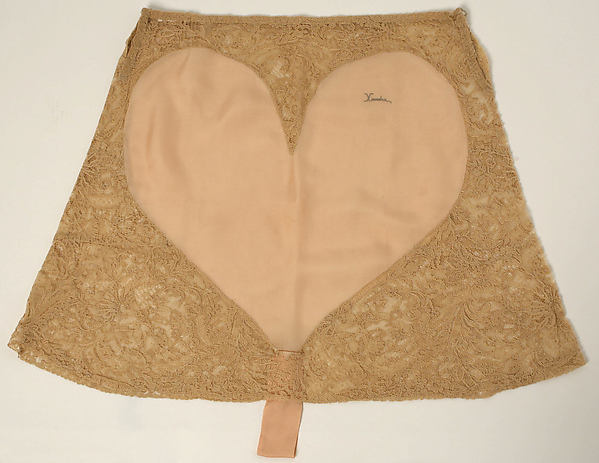
Vintage lace and embroidered tap pants from the 1920's
Tap panties from the Metropolitan Museum of Art

I especially love the use of embroidering one's initials or name into beautiful handmade lingerie. So I decided to sign my work. I set to work in Photoshop with a basic fleur de lis, played around with size and fonts, and came up with a basic template that I could trace onto my fabric and embroider.

Embroidery transfer, how to

I used some transfer paper scraps (look for them at your local thrift shop, so handy!) over a scrap of satin, with my printed test image over that, and traced over it all with a pen.

Pardon the ratty fabric scrap and the horrible photo... I still have no lights in my studio!
 It's definitely a good idea to do a practice version first on the same fabric as your lingerie piece... my practice run was o.k., but I found that the blue silk embroidery thread I was using was just way too thick for my fabric. (I'm still learning! If you'd like to bombard me with embroidery tips, I'll take them gladly!)

Not too great, but it could have been worse :)
 I switched threads and with a bit more care this time, embroidered the same design (minus the center French knot) onto my lace and satin knickers from our last post. It came out much better!

Fleur de lis embroidered monogram, lingerie embroidery

I used a simple back stitch to embroider the whole design. I'm no pro so I won't preach at you about embroidery technique, but here is a great post at Sublime Stitching that shows you this super easy stitch.

Fleur de lis embroidered monogram, lingerie embroidery

And voila! This was really quite easy for a novice embroiderer myself so I strongly encourage you to try it for yourself! Embroidery is so soothing!

Do you plan on adding any other little touches to your French Knickers or other hand-made lingerie? Or do you have a favorite piece of clothing with a tiny, beautiful little embellishment that makes it just that much more dear?