Showing posts sorted by relevance for query sew expensive hat. Sort by date Show all posts

Tuesday, June 4, 2013

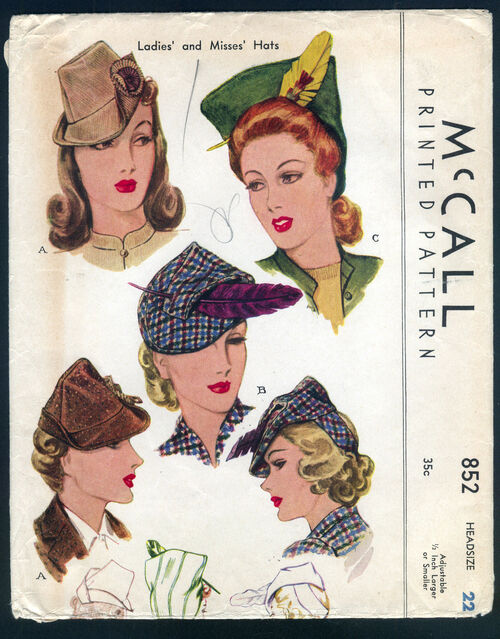
Sew Expensive... McCall 852 1940's Hat Pattern


Hello lovely readers. I am currently sitting at my desk, surrounded by a carefully constructed box fort as big, burly Polish men pack our things up for our move from Norway to California. (If you're wondering, why Polish men, many Polish people choose to immigrate to Norway because there's so much work to be had.)

We're currently in one of those lulls where no one needs my help, and since I'm mostly useless today with a bad head cold (ah, the timing of it all)... I thought I would take a moment to share with you this great pattern in another installment of Sew Expensive!


This beautiful original McCall 852 hat pattern recently sold for an amazing $71.87 on Ebay. While this is  quite a bit of money for a pattern, it's actually pretty reasonable for a 1940's hat pattern. The shape of the hat is rather hard to find, as many hat patterns from this era are much less flattering, or much more basic.

To see the most I have ever seen a vintage hat pattern sell for (it's jaw-dropping, I assure you!), check out this Sew Expensive post.

On another note, if you haven't already, be sure to enter the pattern giveaway being sponsored by Ohhh Lulu!

Well, I'm off to pack some more!

XOXO

Anna

Wednesday, April 15, 2015

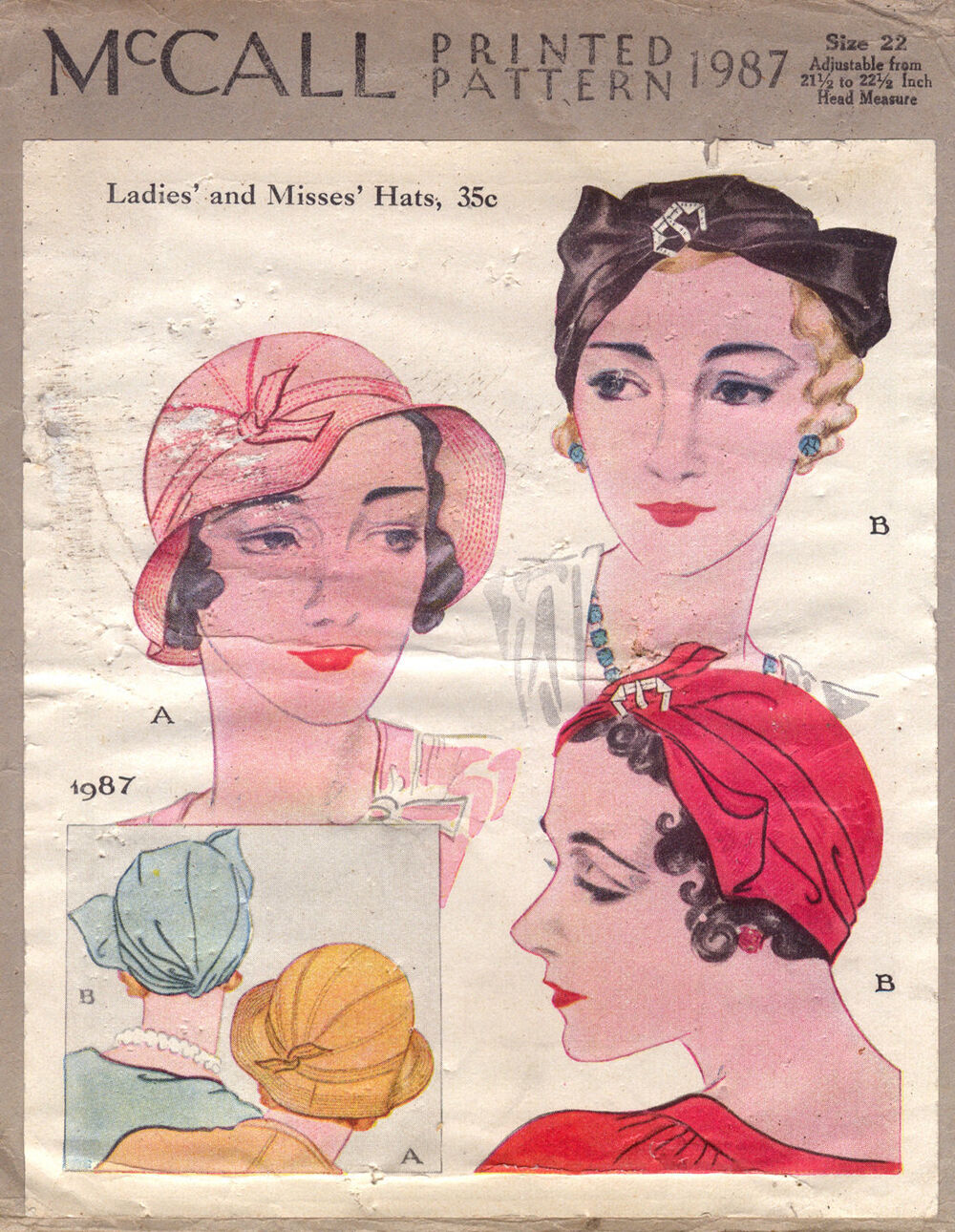
Sew Expensive... A McCall 1987 hat pattern and what makes a buyer tick!


Many of you might come to expect by now that vintage hat patterns are worth a pretty penny. We've watched Millinery for Every Woman and McCall 1974 sell for quite a bit in past editions of Sew Expensive. We know that sometimes the artwork and sometimes the short window that the design was in style can increase a pattern's value.
And today's pattern is no exception to the rule. The artwork is beautiful, the pattern is flattering, and the hat in question was only in style for a short while in the early 1930's.


A few nights ago, I watched the lovely McCall 1987 sell for a predictable, and yet still shocking $223.37.

We've often discussed why patterns sell for more, but why hat patterns, specifically?

In general, accessory patterns don't survive as often as dress patterns. Maybe it's the small pieces, maybe fewer were originally printed, maybe both. But the fact remains that if you find one of these, it might be the only one you find in 20 or 30 years! Version B in this pattern is an especially rare design to see a pattern for. I know it's not in style right now, but don't you just want to wear that hat?

Not too long ago, our last Sew Expensive post got a very exciting comment left on it. A lady named Jan most graciously took the time to comment on the post to explain why she was willing to pay so much for (and she did in fact win!) this, and other patterns. Jan was sweet enough to allow me to share with you her comments, and so I present to you, my dear readers, the mind set behind some of our most Sew Expensive patterns!
----------------------
Pictorial Review 9072 sold at auction or just over $200.

 Jan:
"I had the winning bid on this pattern, and just snagged it by a few dollars margin, and although I really wanted it (see below), assumed it would go for more than my max.

I am also guilty of paying a huge sum for a 30s Vogue Couturier on Feb 24, 2014, for which I paid $643.33:

The original Ebay auction for Vogue 120.

Wednesday, September 12, 2012

Sew Expensive... the pattern of a lifetime.


 I know the posting has been almost non-existent the last week or so. That's because I have been on hiatus, visiting my most excellent mother in Nebraska. We have had a fun week so far of hunting at garage sales and thrift shops for treasure.
One amusing past-time that I recently shared with my mother is stalking Ebay auctions for patterns that I can't afford.
And last night I watched a pattern sell for a literally unbelievable sum.
Allow me to introduce McCall 1794.


This hat pattern makes my eyes water I love it so much. I knew the moment that I saw it that the mere $150 that I was planning on bidding would be nowhere near enough. I have never in my days seen a sewing pattern for a hat of this style.

But, of course, I'm getting ahead of myself. You want to know what the pattern sold for, don't you?
This rare beauty sold last night for a staggering $685.00.
No, that's not a typo. You really are seeing a pattern sell for more than $600.

My mother was stunned. With all of her experience in the antiques world she was at a loss for why it was worth so much and asked me what I thought.

It is difficult to explain. I always say that any vintage pattern is worth what you are willing to pay for it. And clearly it was valuable enough for at least two collectors to bid over $600 each... one person's high bid may have even been in the $700 range.

(On a side note, my mother has never sold an actual hat from this era in all it's original glory for more than $400.)


But why? What is the appeal? We have already discussed the factor the the more beautiful the art on the envelope, the more us collectors drool over it. Another important factor is the hat style itself.
This pattern is dated at 1931 and features a hat style that was only popular for a few years. The close fitting cloche of the 1920's gave way to the soft brim at the end of that decade. Women who couldn't afford regular trips the milliner's sewed new brims onto their existing cloches to stay in vogue.
The fact the a pattern exists for such a short-lived hat is wonderful... we may never see another one like this again, so short is the time it had to be known.

But who would have the budget to buy such a rare gem? A collector, maybe, with a wonderful budget? That is a possibility for sure. Or perhaps someone willing to invest that much in the pattern in order to make a reproduction from it? Maybe. The most likely buyer of this pattern though will probably be a professional costumer for movies or theater. My mother used to work with the very best in the business, helping them procure beautiful clothing, accessories and jewelry for period pieces such as Titanic, The Adams Family, Amistad, and Legends of the Fall (my all-time favorite). It is no stretch of the imagination that they would be willing to pay such a Hollywood price to make near authentic copies for movies.
My hope is that the buyer was someone planning to reproduce the pattern because I don't know about you, but I plan on bringing this hat back into style again!

Wednesday, January 1, 2014

Sew Expensive... Millinery For Every Woman Sewing Book

Hello my dear readers! For you today I have another Sew Expensive moment brought to you by the internet and people with too much money!


For today's installment, I have a stunning book that recently sold for an equally stunning price!


This beautiful, and painfully rare book sold on Ebay recently for a sum that made me quite literally squeal. I scared the hell out of the dog.

This original Millinery for Every Woman by Georgina Kerr Kaye sold for an incredible $587.90 (that's 427 € or 354 £!).

Why would this amazing little tome go for so much, you might ask? Because it's full of hat patterns and very rare millinery knowledge that is slowly dying out. Very few people make their own hats any more compared to the average woman of the 18th century who often knew how to make just about anything. That sort of knowledge is rather scarce these days so a book like this would find a very welcome home among those who wish to preserve that kind of knowledge.

If you're interested in making your own hats, there isn't a lot of info readily available and books like these are not easy to find!
But don't fret, my dears, there is an alternative to spending half your rent on antique millinery books! There are several re-prints of this book currently available on Amazon for as little as $25.

In other news, Happy New Year! Another year has gone by and I find that as a whole, I'm just as content with life as I have been for the last 7 or 8 years.  So no resolutions for me, just happy business as usual.
How about you? Any grand resolutions you hope to keep?

Friday, February 24, 2017

How to count and inventory sewing pattern pieces.


Once a vintage sewing pattern has made its way to your hands, it's a very good habit to inventory the pattern pieces straight away. Make sure that the pattern has all of its pieces and instruction sheets before putting it away. That way, you can leave accurate feedback or address any concerns with the seller as soon as possible. It's also handy when you're finally ready to sew it.

This one is missing A, B and E, (the cup and strap pieces.) I don't care, I love it anyways!

Imagine: you've pulled the pattern out of a drawer, made plans, bought fabric, and as you lay the pattern pieces out, you're missing half of them!
I've been there. The downside was that I had bought the pattern for $30 the year before, advertised as complete, and I didn't check it when it came in the mail! My return window had come and gone.

So how do you tell how many pieces your pattern should have?
Most of the time this information will be on the back of the envelope, as you can see here from my vintage McCall's 6276.

Don't actually draw on your vintage pattern envelopes in pen. It's bad, m'kay?
There is an exception to this, and it's a tricky one. Certain vintage patterns (often doll, accessory and hat patterns) will all be printed out on one or two sheets, and the companies sometimes just listed "2 pieces" as you see below.


In this case, you need to count the pieces illustrated instead.

You need to also make sure that the pattern has the instructions! Keep in mind that a few companies (I'm looking at you, vintage Vogue) had more than one instruction sheet. Make sure that if you only have one instructions sheet, that it has both the sewing instructions, AND the cutting layout diagrams.

A handy way to keep track of this all is to use a simple inventory sheet. I've put a quick one together for you below. On the back you can always make a list of the pattern pieces (i.e. A, B, C or 1, 2, 3) and then check them off as you count them.


I will print a sheet of 9 of these on one page, cut them out, and keep a completed one with each pattern I've counted.
And last but not least, if your pattern is printed, it's a good idea to make sure that the 10 pieces you have in an envelope are the actual 10 pieces that belong in it. Double check the pattern number (and even the size if you have time) printed on each pattern piece. I recently purchased a pattern online, checked the pieces, and it had 10 pieces as advertised, but one was for a completely different pattern - an honest mistake, but one that is avoidable if you have the time.

But wait, what do you do if you go to all of that trouble and pieces are missing! Assuming you don't return it to the seller (not if you got it for pennies at a thrift shop!), what are your options. You have some great ones, actually!
I'm one of the Admins for a great little Facebook group that you will love! The goal of the Vintage Pattern Pieces Lost and Found Group is to complete every missing pattern we can find! You can join the group, post your pattern with a photo/ description of what you're missing and wonderful, helpful collectors will search their archives and try to make copies of what you're missing!

Another option is to find another copy of your pattern for sale and message the seller asking if they would consider tracing a copy of your missing piece.

This pattern is missing a couple of pieces and I'm still SO happy to have it in my collection!

Whatever you do, please don't throw away incomplete patterns! Even an empty envelope or a stray instruction sheet is valuable to a collector. I still buy incomplete patterns all the time, and I know many other collectors who do the same - many of us like a challenge!

A new organization headed by a dear friend of mine is designed to be a rehabilitation and matchmaking destination for incomplete patterns. You can donate your extra pattern pieces, incomplete patterns, empty envelopes, spare instructions and old pattern tracings to the Vintage Sewing Pattern Catalog Graveyard. All pieces from all eras are welcome and each piece will be catalogued and hopefully someday united with a pattern to call home.


How about you? Do you have any tips/ pattern counting tricks that you find useful?

Happy sewing!


Other sewing pattern related articles you might find helpful:

How to properly mend sewing patterns.

How to add a sewing pattern to the Vintage Pattern Wiki.

Using Evernote to catalog your sewing pattern collection.

Helpful Hints for vintage patterns sellers.

Sew Expensive... A McCall 1987 hat pattern and what makes a buyer tick!

What constitutes a sewing pattern.

Monday, February 20, 2017

How to Properly Mend Sewing Patterns


Pattern repair and preservation are topics that don't come up very often unless you're a die-hard pattern collector or an experienced sewing pattern seller. Many people might reasonably assume that a sewing pattern or envelope with tears is worth less than one without. That makes sense. What they might not know, is that a pattern or envelope that have been repaired with any kind of tape is likely worth LESS than a torn, un-repaired one.
Here is why.


Tape adhesive can degrade and change color over the years. While it might be a temporary repair, old tape can eventually weaken the paper surrounding it, stain the pattern paper, and in some cases eat through delicate tissue leaving nothing but a shredded, inflexible plastic remnant.

I thought that I would put together a quick guide to pattern repair for anyone who is interested. If you have any suggestions gleaned from your own collecting experience, please do leave a comment to share with us!

Allow me to first say though, that this is not a lecture or condemnation to those who have taped their patterns in the past. Your pattern is your property to do with as you wish, and I would simply be happy to teach you a way to help those damaged patterns to not only survive longer, but also retain their value and integrity in the future!

Pattern sellers should pay special attention to how, and if, they choose to repair their sewing patterns. Collectors like myself are not terribly concerned with a torn piece or envelope here or there, but we are VERY concerned with patterns that have been taped in any way. It is always safer to leave a pattern un-repaired and let the buyer fix it themselves if they are so inclined.


The basics:
Do not tape any part of a pattern or envelope with scotch or any other regular tape. Things to avoid using include shipping tape, masking tape, duct tape, washi tape, staples, sewing pins and paper clips. All of these can do more eventual harm than good.